 Dough & Brine
Ciabatta with an open crumb
These ciabatta loaves have a deeply golden crust and an irregular, open crumb. Adding the water gradually builds elasticity, while folds strengthen the wet dough without pressing out its air.
- Hydration
- 80%
- Rise time
- 3.8 hours
- Hands-on
- 30 min
- Oven
- 250 °C (475 °F), conventional heat

Method
- Mix 500 g bread flour, 3 g instant yeast, 10 g fine salt, and 350 g water until no dry flour remains. Reserve the remaining 50 g water for kneading.
- Knead with a dough hook at low to medium speed for 10 minutes, adding the reserved 50 g water in small additions once the dough holds together. Aim for a dough temperature of 24 °C (75 °F) and an elastic dough that stretches into a thin membrane; it will remain very loose and sticky.Do not add flour to make the dough easier to handle.
- Transfer the dough to a rectangular dough container moistened with water, cover, and let rise at 24 °C (75 °F) for 30 minutes. Look for the dough to relax and spread across the bottom.
- With wet hands, fold the dough from each of its four sides toward the center, then cover and let rise at 24 °C (75 °F) for 30 minutes. Look for the dough to begin holding more tension.
- Repeat the fold from all four sides with wet hands, then cover and let rise at 24 °C (75 °F) for 30 minutes. Check for bubbles appearing along the sides of the container.
- Gently fold the dough from all four sides toward the center for the third and final time, then cover and let rise at 24 °C (75 °F) for 1½ hours. Wait until it has roughly doubled, looks airy, and jiggles when you move the container, allowing longer if needed.
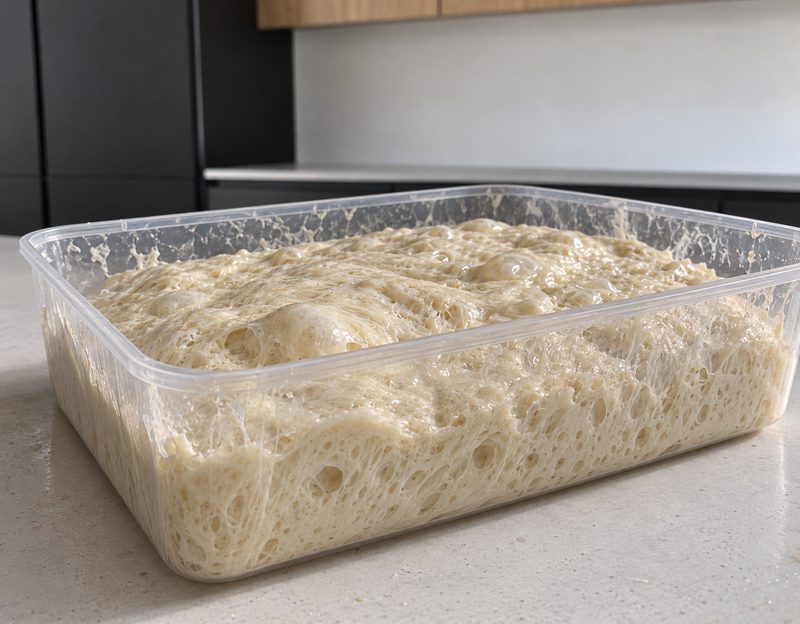
After the bulk rise, the wet dough is full of bubbles. - Use part of the 30 g dusting flour on the work surface, gently turn out the dough, and dust its top; ease it into a rectangle without flattening it and divide into two elongated pieces with a dough scraper. Use floured hands to transfer the pieces to generously floured parchment without rounding or shaping them tightly.Use the remaining dusting flour for the dough, parchment, and your hands.
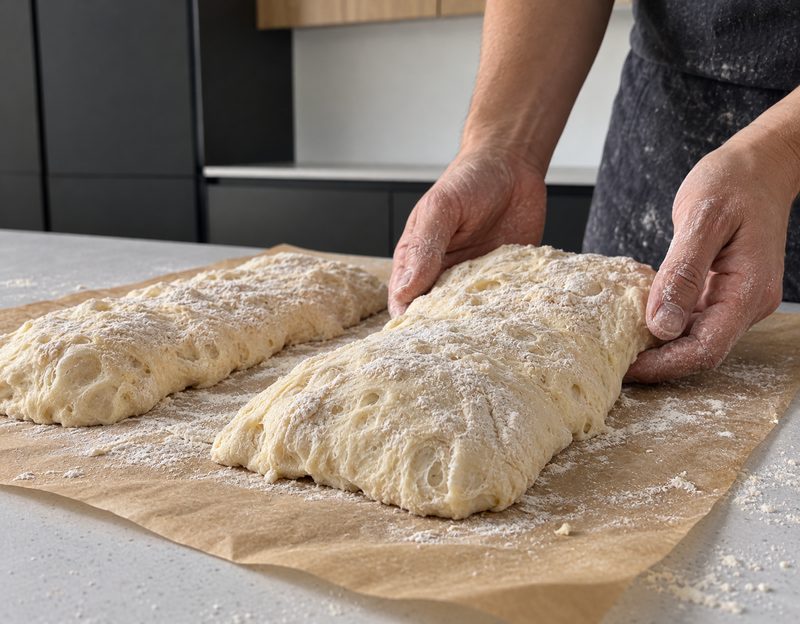
Divide the dough gently without pressing out the air. - Cover with an inverted deep container and let proof at 24 °C (75 °F) for 45 minutes, until slightly fuller and very airy, with a light indentation returning slowly and only partway. At the start of this proof, preheat the oven on conventional bake (fan off) to 250 °C (475 °F) for 45 minutes, with a baking steel or pizza stone below the middle rack position and a metal roasting pan at the bottom.A thick pizza stone is not always fully heated after 45 minutes; a baking steel is.
- Slide the loaves and parchment onto the hot baking surface, using a pizza peel or upside-down baking sheet that you set the parchment on beforehand. Carefully pour 100 ml boiling water into the roasting pan, close the door immediately, and bake at 250 °C (475 °F) for 10 minutes. Briefly open the door to release steam, pull the parchment out from under the loaves, reduce to 230 °C (450 °F), and bake for 15 to 20 minutes more, until deeply golden with a center temperature of 96 to 98 °C (205 to 208 °F).Keep your hands and face away from the steam when adding water and opening the oven.
- Cool the loaves uncovered on a wire rack for 60 minutes, until fully cool, before slicing so the moist crumb can set.Store fully cooled bread in a paper bag at room temperature for up to 2 days, or freeze whole or sliced for up to 90 days.


Food safety
- Do not taste raw dough: raw flour can carry pathogens. Wash your hands and the counter after handling the dough.
- Do not pour the boiling water near the oven glass; it can crack. Open the oven door at arm's length and keep your face away: a cloud of steam comes out.
- Contains: gluten (wheat).
In your log
Tick it off and it goes into your log with the date.
Stays in this browser only.
When it goes wrong
| What you see | Likely cause | Next time |
|---|---|---|
| The dough tears instead of stretching into a thin membrane. | The gluten is not sufficiently developed, or the reserved water was added too quickly. | Let the dough gain cohesion before adding the reserved water in small additions. |
| The dough spreads excessively and holds little tension. | The dough has insufficient strength, possibly from weak flour or missed folds. | Use bread flour and complete each fold at its specified stage. |
| The dough has few bubbles at the end of bulk fermentation. | Fermentation is incomplete, particularly if the dough is cooler than intended. | Maintain 24 °C (75 °F) and wait for the dough to roughly double and jiggle before dividing. |
| The loaves have a tight crumb despite an airy bulk rise. | Too much gas was pressed out during dividing or transfer. | Support the dough gently and avoid flattening, rounding, or tight shaping. |
| The loaves spread and barely rise in the oven. | The dough may have proofed beyond its useful strength. | Bake when the pieces feel airy and a light indentation returns slowly and partially. |
| The crust is pale and the base is soft. | The baking surface was not fully heated, or baking ended too soon. | Preheat the steel or stone for 45 minutes and bake to a deeply golden crust. |
| The crumb feels gummy when sliced. | The bread was sliced warm or was not fully baked. | Check for a center temperature of 96 to 98 °C (205 to 208 °F) and cool uncovered for 60 minutes before slicing. |