 Dough & Brine
Focaccia: airy Italian flatbread
This focaccia has an open, tender crumb, a crisp golden base, and rosemary tucked into its dimpled surface. Strong bread flour and folds support the wet dough, while cold fermentation develops flavor.
- Hydration
- 80%
- Rise time
- 22 hours
- Hands-on
- 30 min
- Pan
- 35 × 25 cm (14 × 10 in)
- Oven
- 230 °C (450 °F), conventional bake (fan off)

Method
- Combine 500 g bread flour, 400 g water, 10 g fine sea salt, and 2 g instant yeast in the stand mixer bowl. Mix for 2 minutes until no dry flour remains.
- Knead with the dough hook on low to medium-low speed for 8 minutes, gradually adding 20 g extra virgin olive oil after 4 minutes of kneading. Aim for a cohesive, elastic dough that is still sticky.Avoid adding flour to make the dough easier to handle; its stickiness is expected.
- Cover the bowl and let the dough rise at 22 °C (72 °F) for 30 minutes.
- With wet hands, stretch the dough from each of its four sides and fold it over itself. Cover and let rise at 22 °C (72 °F) for 30 minutes.Lift gently and stop before the dough tears.
- With wet hands, stretch the dough from each of its four sides and fold it over itself again. Cover and refrigerate at 4 °C (39 °F) for 18 hours.Keep the dough covered securely so the surface does not dry out.
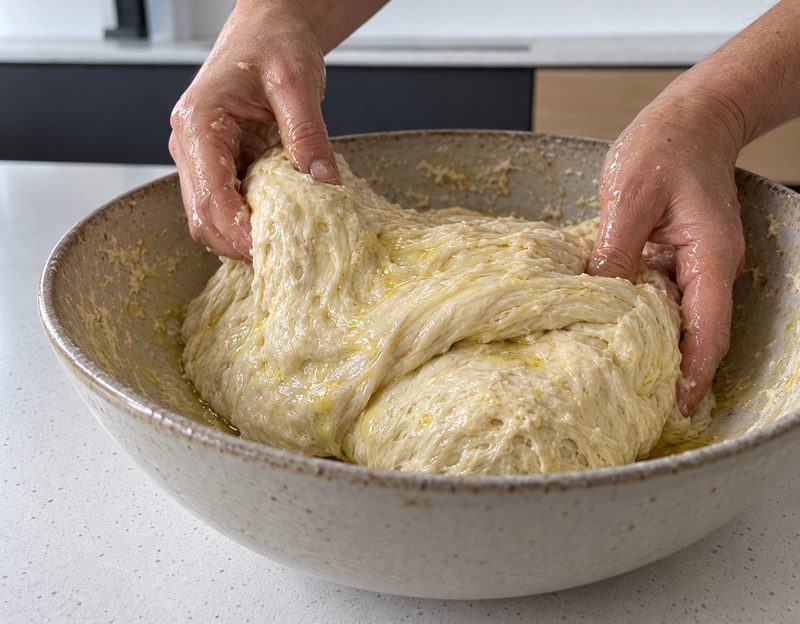
After folding: wet, glossy and holding its shape. - Coat a 35 × 25 × 5 cm (14 × 10 × 2 in) rectangular metal pan with all 38 g extra virgin olive oil reserved for the pan, then transfer the cold dough into it and gently stretch it partway across the base. Cover and let rise at 22 °C (72 °F) for 30 minutes.Do not force the cold dough into the corners; it will stretch more easily after resting.
- Gently stretch the relaxed dough into the corners, cover, and let rise at 22 °C (72 °F) for 2½ hours, until visibly puffy, bubbly, and jiggly when the pan is moved gently. During the last 30 minutes of this rise, preheat the oven to 230 °C (450 °F) using conventional bake (fan off).Keep the covering clear of the dough so it does not stick to the rising surface.
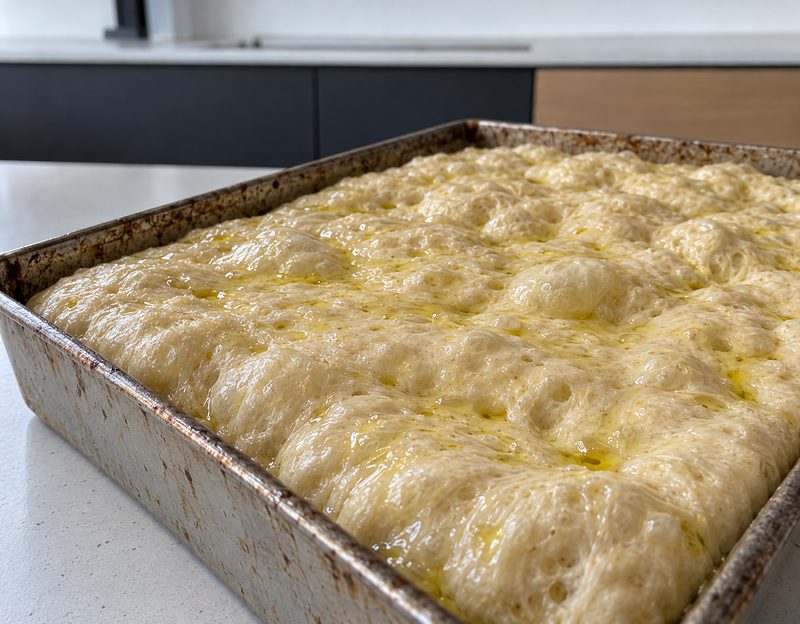
Risen into the corners, with bubbles on the surface. - Remove the covering, toss 2 g fresh rosemary leaves with the 20 g extra virgin olive oil reserved for the topping, and distribute the rosemary and oil over the dough. With oiled fingertips, press deep dimples down to the pan without flattening the dough, then scatter over 3 g flaky sea salt.Coating the rosemary in oil helps protect it from scorching.
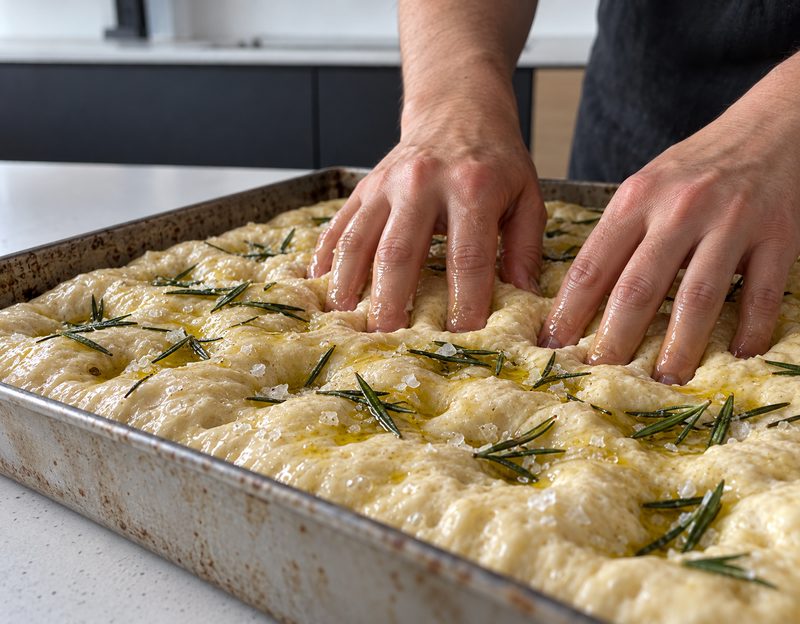
Pressing dimples all the way to the bottom of the pan. - Bake below the center of the oven at 230 °C (450 °F) for 22-28 minutes, until the top is golden brown and the underside is crisp and golden.Carefully lift an edge with a spatula to check the underside.
- Let the focaccia cool in the pan for 5 minutes, then remove it and place it on a wire rack. Cool on the rack for 20 minutes before slicing.Leaving it in the pan traps steam and softens the base. Store cooled focaccia airtight at room temperature for up to 2 days, or freeze it in pieces; reheat in a hot oven.


Food safety
- Do not taste raw dough: raw flour can carry pathogens. Wash your hands and the counter after handling the dough.
- Contains: gluten (wheat).
In your log
Tick it off and it goes into your log with the date.
Stays in this browser only.
When it goes wrong
| What you see | Likely cause | Next time |
|---|---|---|
| The dough tears during folding. | It was stretched beyond its current elasticity. | Use wet hands and fold gently, stopping when the dough resists. |
| The cold dough springs back in the pan. | The gluten is still tight from the cold. | Stretch it only partway before the covered pan rest, then ease it into the corners afterward. |
| The baked crumb is dense with few bubbles. | The final rise was incomplete, or handling pressed out too much gas. | Look for a puffy, bubbly dough that jiggles before dimpling, and avoid flattening it. |
| The surface develops a dry skin. | The dough was not fully covered during fermentation. | Keep it covered throughout every rise and remove the covering only when preparing the topping. |
| The base is pale and soft. | The oven was not fully preheated, or the underside needed more baking within the stated range. | Complete the preheat, bake below the center, and check the underside before removing the focaccia. |
| The rosemary tastes scorched. | The leaves were exposed without enough oil coating. | Toss the rosemary thoroughly in the reserved topping oil before distributing it. |
| The base loses its crispness after baking. | Steam was trapped beneath the focaccia. | Remove it from the pan after 5 minutes and finish cooling on a wire rack. |