 Dough & Brine
Cinnamon rolls
These cinnamon rolls have a soft, tender crumb and a defined cinnamon-sugar swirl. Kneading before adding the butter builds strength, while covered rises keep the dough supple as it expands.
- Hydration
- 54%
- Rise time
- 2.5 hours
- Hands-on
- 35 min
- Pan
- 33 × 23 cm (13 × 9 in)
- Oven
- 180 °C (350 °F), conventional

Method
- Weigh the dough, filling, and glaze ingredients separately, and let both portions of butter soften without melting. Line the bottom and sides of a 33 by 23 cm (13 by 9 in) rectangular metal baking pan with parchment.The butter should yield easily when pressed but still hold its shape.
- Warm the 270 g whole milk to 28 °C (82 °F), and combine 500 g bread flour, 7 g instant yeast, 70 g granulated sugar, and 10 g fine salt in a mixing bowl. Add the milk and 50 g egg, then mix until no dry flour remains.
- Knead in a stand mixer with the dough hook on low to medium speed for 5 minutes, then add the 70 g softened dough butter in portions and knead for another 7 minutes. Shape the smooth, elastic dough into a ball and cover the bowl.A small piece of dough should stretch into a thin membrane without tearing.
- Let the covered dough rise at 24 °C (75 °F) for 1½ hours, until roughly doubled in volume.Use the change in volume as well as the stated time to judge the rise.
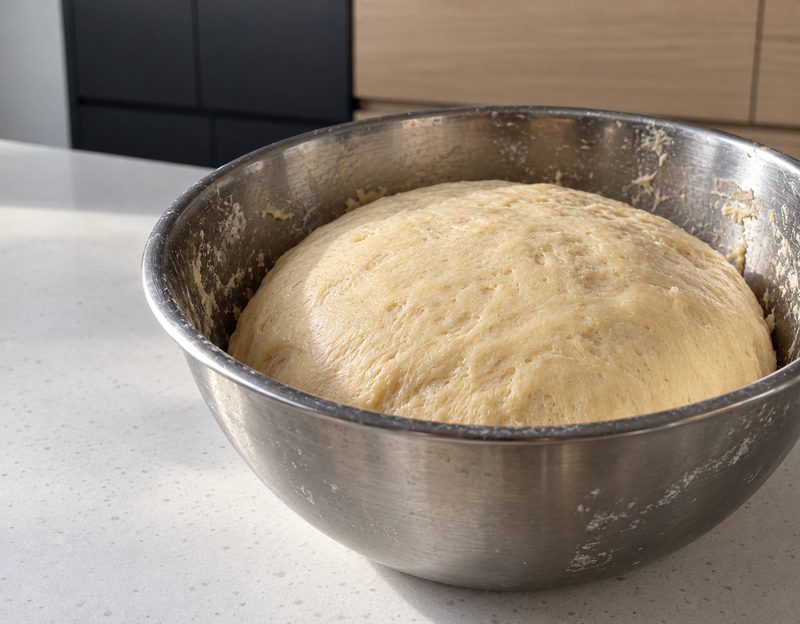
After the first rise, the dough has roughly doubled in size. - Mix 60 g softened filling butter with 100 g light brown sugar and 10 g ground cinnamon. Roll the risen dough into a 40 by 30 cm (16 by 12 in) rectangle on a lightly floured surface, then spread with the filling, leaving a 2 cm (¾ in) border along one long edge.Use the 15 g dusting flour as needed to prevent sticking.
- Starting at the opposite long edge, roll the dough into a 40 cm (16 in) log, pinch the seam closed, and cut into 12 equal pieces. Arrange cut-side up in the prepared pan in 3 rows of 4, then cover.Use a sharp blade and avoid pressing down on the spirals as you cut.
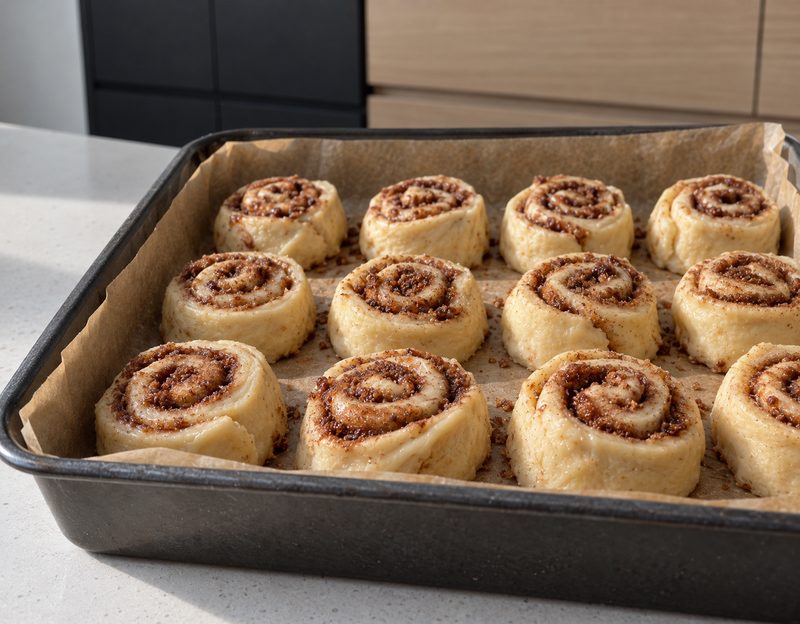
Arrange the sliced rolls in the pan with space between them. - Let the covered rolls rise at 24 °C (75 °F) for 1 hour, until visibly puffy, nearly touching, and slow to spring back from a light finger press. During the final 20 minutes of this rise, preheat the oven to 180 °C (350 °F) on the conventional setting (not convection).
- Remove the cover and bake in the middle of the oven for 23 to 28 minutes. Check that the rolls are golden brown and the center roll reaches an internal temperature of 88 to 90 °C (190 to 194 °F).Insert the thermometer into the dough of the center roll, not into the cinnamon filling. Tent loosely with aluminum foil if the tops darken before the centers are baked.
- Set the pan on a wire rack and let the rolls cool in the pan for 20 minutes.
- Stir 80 g powdered sugar with 15 g water until smooth, then spread the glaze over the still-lukewarm rolls.Once fully cool, store airtight at room temperature for 2 days, or freeze individually wrapped on the day of baking for up to 3 months; thaw in the wrapping at room temperature.


Food safety
- Do not taste raw dough: raw flour and raw egg can carry harmful bacteria. Wash your hands and the counter after handling the dough.
- Contains: gluten (wheat), milk, egg.
In your log
Tick it off and it goes into your log with the date.
Stays in this browser only.
When it goes wrong
| What you see | Likely cause | Next time |
|---|---|---|
| The dough tears instead of stretching into a thin membrane. | The gluten is not sufficiently developed. | Complete the kneading before and after adding the butter, and check the dough's stretch before the first rise. |
| The dough has barely expanded during the first rise. | The dough is too cool, or the yeast is inactive. | Use active instant yeast, warm the milk to 28 °C (82 °F), and keep the covered dough at 24 °C (75 °F). |
| The dough pulls back while being rolled out. | The dough is still tight or the first rise was incomplete. | Let the first rise reach roughly double the original volume and roll gently rather than forcing the dough. |
| The sliced rolls look flattened or uneven. | The log was compressed during cutting. | Use a sharp blade and cut without pressing the log flat. |
| The baked rolls are dense, with tight centers. | The shaped rolls were underproofed. | Check that the rolls are puffy, nearly touching, and slow to spring back before baking. |
| The tops are dark but the centers are underbaked. | The surface browned before heat reached the centers. | Bake on the middle rack and tent loosely with foil if needed; check the center roll for 88 to 90 °C (190 to 194 °F). |
| The glaze runs off and disappears into the rolls. | The rolls were too hot when glazed. | Cool them in the pan on a rack for 20 minutes and apply the glaze while they are lukewarm. |