 Dough & Brine
Neapolitan pizza dough
This dough bakes into a thin center with a tender, airy rim. Tipo 00 flour and a long cold fermentation develop an extensible dough that stretches easily while holding gas around the edge.
- Hydration
- 65%
- Rise time
- 28 hours
- Hands-on
- 25 min
- Oven
- highest setting

Method
- Mix 595 g tipo 00 flour, 386 g cold water, 18 g fine sea salt, and 1.2 g instant yeast until no dry flour remains. Knead for 10 minutes, until the dough is smooth and elastic.Use a dough scraper to gather sticky dough rather than adding more flour.
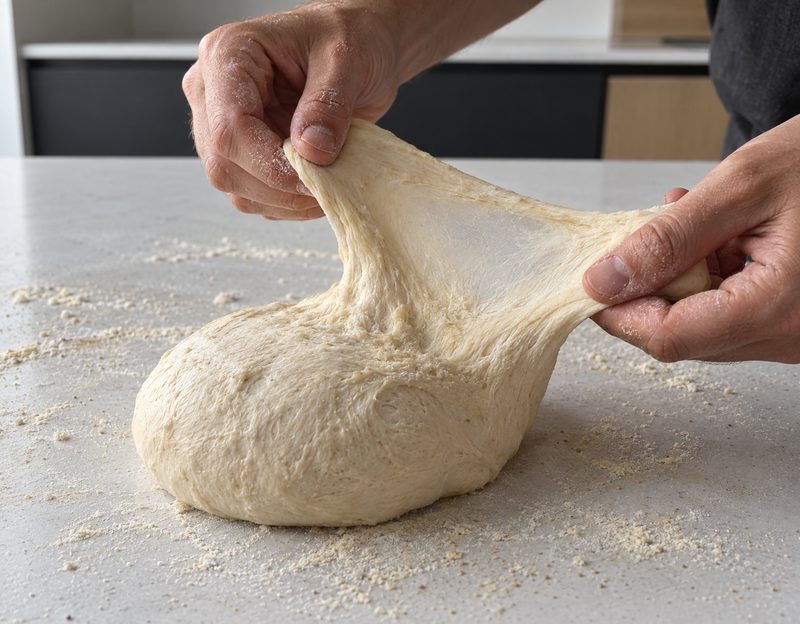
After ten minutes of kneading: smooth, with a thin windowpane. - Cover the dough and let it rise for 2 hours at 21 °C (70 °F).Keep the container covered so the surface stays supple.
- Divide the dough into 4 portions of 250 g and shape each into a ball. Draw the surface taut and pinch the seam closed without tearing the dough.
- Place the balls in covered dough containers and refrigerate for 24 hours at 4 °C (39 °F).Leave room around each ball so it can expand without sticking to its neighbors.
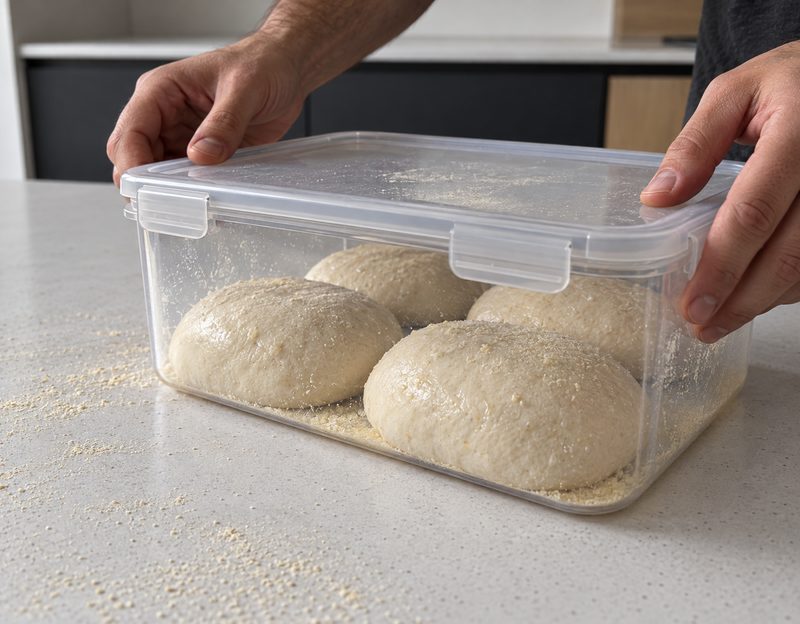
Four balls in a sealed box, ready for the fridge. - Let the covered dough balls rise for 2 hours at 21 °C (70 °F), until soft and slightly expanded. Allow up to 3 hours in a cool kitchen.Keep the balls covered while they warm to prevent a dry skin.
- For a home oven, preheat at the highest setting with a baking steel for 45 minutes or a pizza stone for 60 minutes, set on the top rack about 15 to 20 cm (6 to 8 in) below the broiler. For a pizza oven, preheat for 20 minutes to 430-480 °C (800-900 °F).Start preheating during the final rise so the baking surface is ready when the dough is.
- Use the 30 g semolina to dust the work surface and peel, then press each dough ball outward from the center, leaving the rim untouched. Stretch gently, transfer to the peel, and add your toppings.Check that the dough slides freely on the peel before loading it into the oven.
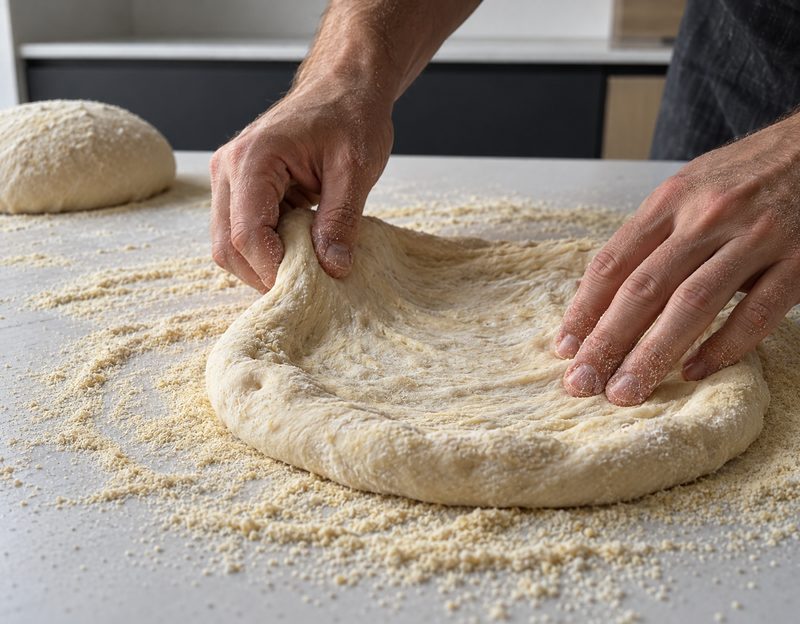
Stretching on semolina, leaving the rim alone. - In a home oven, bake on steel for 6-9 minutes or on stone for 8-12 minutes, using the broiler for the last 1-2 minutes for dark spots on the rim. In a pizza oven at 430-480 °C (800-900 °F), bake for 60-90 seconds, turning a quarter turn every 20-30 seconds.Watch the rim and underside together; the crust should be colored and the center set.


Food safety
- Do not taste raw dough: raw flour can carry pathogens. Wash your hands and the counter after handling the dough.
- Contains: gluten (wheat).
In your log
Tick it off and it goes into your log with the date.
Stays in this browser only.
When it goes wrong
| What you see | Likely cause | Next time |
|---|---|---|
| The dough snaps back while stretching. | The dough is still cold or tight. | Let the balls complete the final rise and check that they feel soft before stretching. |
| The dough tears during shaping. | The gluten is underdeveloped, or the center has been stretched too thin. | Knead until smooth and elastic, then stretch gradually without pulling from a single point. |
| The dough has a dry skin. | The container was not sealed well during fermentation. | Keep the dough covered through both room-temperature rises and refrigeration. |
| The baked rim is flat and dense. | The edge was pressed flat during shaping, or the dough was not ready to bake. | Leave the rim untouched and wait until the balls feel soft and slightly expanded. |
| The pizza sticks to the peel. | The peel was insufficiently dusted, or the topped dough sat on it too long. | Distribute the semolina evenly and check that the pizza slides before loading. |
| The underside is pale while the top is browned. | The baking surface was not fully preheated. | Give the steel or stone its full preheat before loading the pizza. |
| The semolina tastes burnt. | Excess loose semolina scorched on the baking surface. | Use a light dusting and shake off loose semolina before loading. |
| The pizza oven crust burns on one side. | The pizza stayed facing the heat for too long. | Turn the pizza regularly throughout the bake. |