 Dough & Brine
Homemade sauerkraut
Finely shredded cabbage turns crisp and tangy as it ferments in its own brine. Salt draws out the cabbage's moisture, while a fermentation weight keeps it submerged and an airlock lets gas escape.
- Salt
- 2%
- Fermenting
- 28 days
- Hands-on
- 30 min
- Jar
- 1.5 liter
- Keeps
- 90 days

Fermenting safely
- Keep the vegetables under the brine. Anything above the liquid can grow mold.
- Use a clean jar and serve with a clean utensil, so no food scraps end up inside.
- A flat, white, non-fuzzy film on top is usually kahm yeast: skim it off, check that everything is under the brine and measure the pH again. Fuzzy or colored mold, pink or dark vegetables, slime or a rotten smell: throw it all out, do not taste.
- This has not been heat-processed: refrigerate it as soon as fermenting is done (4 °C / 39 °F or below) and keep it there.
- Check the pH with a calibrated pH meter. Only at 4.0 or lower is it ready to refrigerate and taste. If the pH is still higher at the end of the longest fermentation time, or you are unsure: throw it out.
Method
- Thoroughly clean a 1500 ml jar, fermentation weight, and utensils. Rinse the trimmed cabbage before finely shredding it, then weigh out 1000 g.Weigh the cabbage after removing the outer leaves and hard core.
- Add 20 g fine additive-free salt to the cabbage and massage for 10 minutes, working until it releases plenty of liquid.
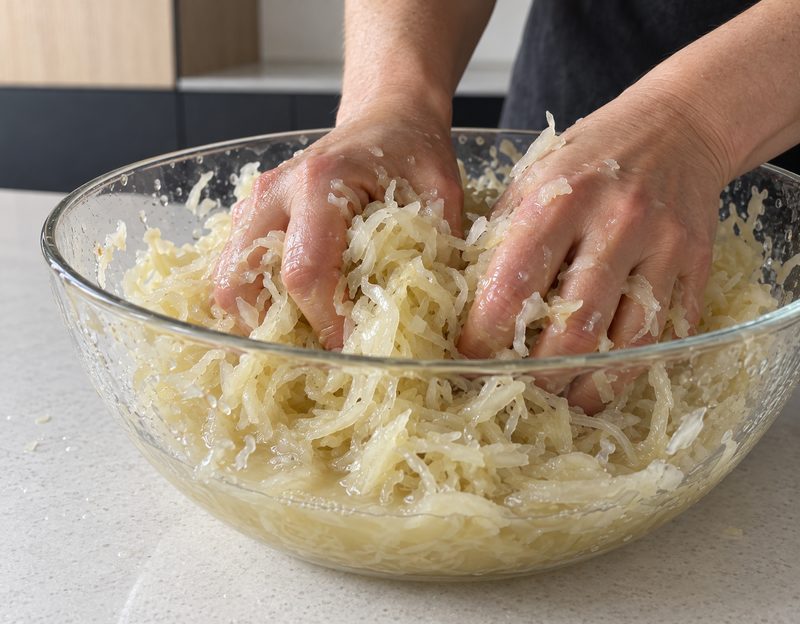
Kneading with the salt until the liquid runs. - Let the salted cabbage rest for 30 minutes.Keep all the released liquid; it will become the brine.
- Pack the cabbage firmly into the clean jar, pressing out trapped air. Add all the liquid released during massaging and resting.
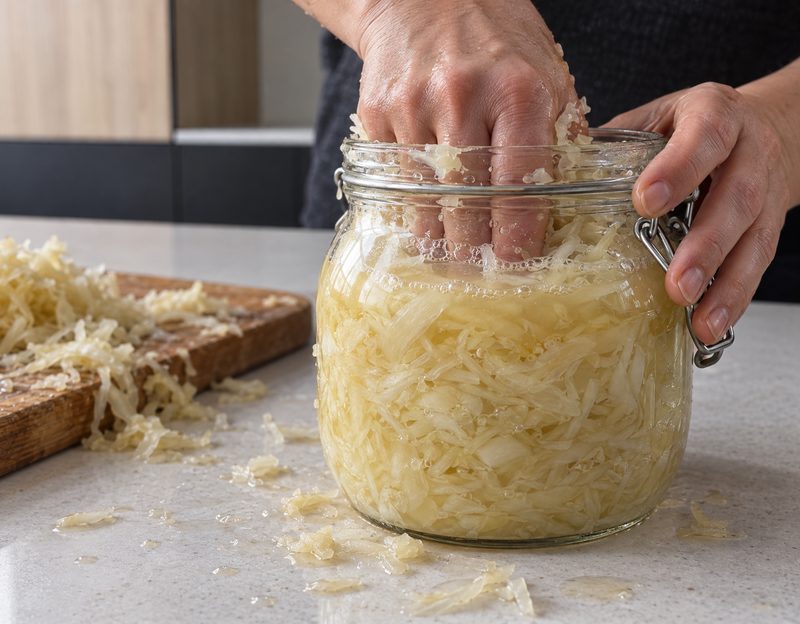
Packing firmly until the brine rises above the cabbage. - Place the fermentation weight over the cabbage and keep the brine 2 cm (¾ in) above both the cabbage and the weight, leaving 4 cm (1½ in) of headspace above the brine. If the cabbage's own liquid is insufficient, top up with brine made from 20 g salt per liter of water.Check for loose shreds floating above the weight and tuck them beneath it.
- Close the jar with an airlock and place it out of direct sunlight. Keep it on a plate or tray for the first week to catch any overflow.
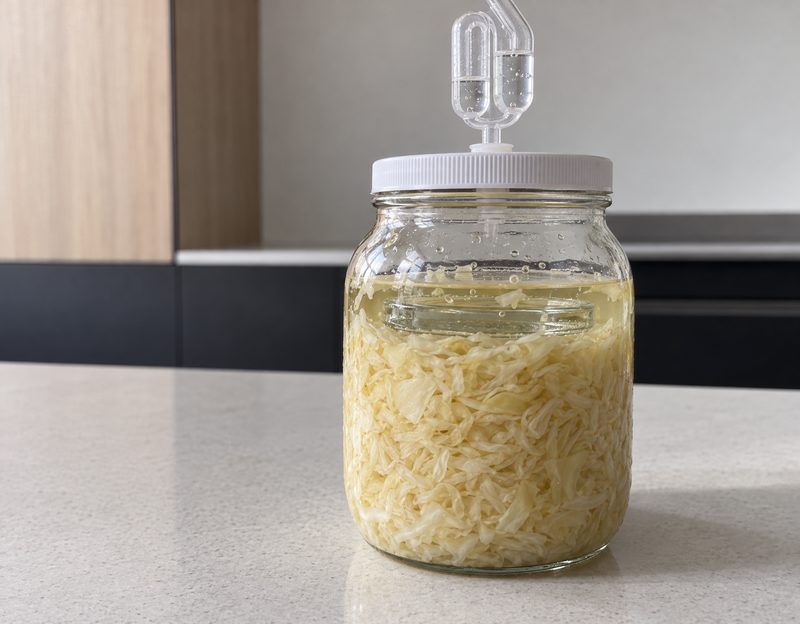
Weight on top, 2 cm (¾ in) of brine above, airlock on the jar. - Ferment for 28 days at 19 °C (66 °F), keeping the temperature within 18-22 °C (64-72 °F). Check daily that all the cabbage remains submerged and that the airlock is filled to its marked line.Discard the batch immediately if you see fuzzy mold or notice a putrid odor or slimy texture; do not taste it.
- Starting on day 21, measure the pH with a calibrated pH meter before tasting. Taste only if the pH is 4.0 or lower, and never return tasted cabbage or brine to the jar.Use clean utensils to remove a sample.
- If the pH remains above 4.0 and there are no signs of spoilage, continue fermenting and measure again every 3 to 4 days, up to a maximum of 42 days. Do not taste while the pH is above 4.0, and discard the batch if it is still above that target at 42 days.
- If the pH is 4.0 or lower and there are no signs of spoilage, refrigerate the sauerkraut right away at 4 °C (39 °F) or below and keep it there for up to 90 days. Keep the cabbage submerged in brine.Use clean utensils whenever serving, and discard it if signs of spoilage develop.


In your log
Tick it off and it goes into your log with the date.
Stays in this browser only.
When it goes wrong
| What you see | Likely cause | Next time |
|---|---|---|
| Cabbage or loose shreds rise above the brine | The cabbage is not held securely beneath the weight | Pack firmly, tuck loose shreds beneath the weight, and check submersion daily. |
| There is not enough liquid to cover the cabbage and weight | The cabbage released too little juice | Massage and rest as directed, then top up with brine made from 20 g salt per liter of water if needed. |
| Brine overflows from the jar | Fermentation gas lifts the packed cabbage and raises the liquid level | Leave 4 cm (1½ in) of headspace above the brine and keep the jar on a plate or tray for the first week. |
| Bubbles appear in the cabbage or airlock, or the brine turns cloudy | Fermentation is producing gas and lactic acid bacteria | Maintain the airlock and keep the cabbage submerged; use the measured pH, not bubbles or cloudiness, to assess acidity. |
| The pH is still above 4.0 after 28 days | Acidification has not yet reached the target | Keep the temperature within 18-22 °C (64-72 °F) and verify the meter's calibration; without spoilage, continue checking every 3 to 4 days, but discard if still above target at 42 days. |
| Fuzzy mold, a putrid odor, or a slimy texture develops | Spoilage has occurred | Discard without tasting; next time, clean equipment thoroughly, maintain submersion, and check the airlock daily. |
| The airlock liquid falls below its marked line | Liquid has evaporated or escaped | Check the fill level daily and maintain it at the marked line. |